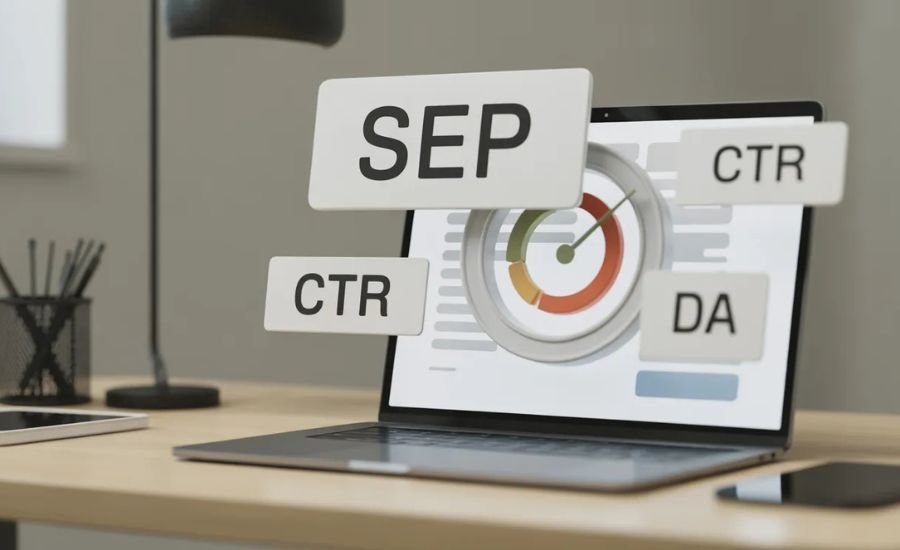
SEO has its own language. If you have ever looked at a report and wondered what SERP, CTR, or DA actually mean, you are not alone.
Search engine optimization is full of abbreviations. For beginners, it can feel like trying to learn a new alphabet. This guide breaks down 75 common SEO abbreviations in simple, plain English so you can understand what matters and why.
Whether you run a business, manage marketing, write content, or are just getting started with SEO, this glossary will help you make sense of the terminology.
Core SEO Abbreviations
1. SEO – Search Engine Optimization
SEO is the process of improving your website so it ranks higher in search engines like Google and attracts organic traffic.
2. SERP – Search Engine Results Page
The SERP is the page you see after you search for something on Google.
3. CTR – Click-Through Rate
CTR is the percentage of people who click your link after seeing it in search results.
4. CPC – Cost Per Click
CPC is the amount you pay each time someone clicks your ad.
5. CPA – Cost Per Acquisition
CPA measures how much it costs to gain one customer or lead.
6. ROI – Return on Investment
ROI shows whether your SEO efforts are profitable compared to what you spend.
7. KPI – Key Performance Indicator
A KPI is a measurable metric used to track performance, such as traffic or conversions.
8. CMS – Content Management System
A CMS is software that allows you to manage website content. WordPress is a common example.
9. UX – User Experience
UX describes how easy and enjoyable your website is to use.
10. UI – User Interface
UI refers to the design elements users interact with, such as buttons and navigation.
On-Page SEO Abbreviations
11. H1 – Heading 1
The main headline of a webpage. Every page should have one clear H1.
12. H2 / H3 – Subheadings
Subheadings organize content and make it easier to read.
13. ALT – Alternative Text
ALT text describes an image so search engines and screen readers can understand it.
14. URL – Uniform Resource Locator
The URL is the web address of a page.
15. CTA – Call to Action
A CTA encourages users to take action, such as signing up or contacting you.
16. Meta Title
The clickable headline that appears in search results.
17. Meta Description
The short summary under your title in search results.
18. KW – Keyword
A keyword is the phrase someone types into a search engine.
19. LSI – Latent Semantic Indexing
LSI refers to related terms that help search engines understand context.
20. IA – Information Architecture
IA is how your website content is structured and organized.
Technical SEO Abbreviations
21. HTML – HyperText Markup Language
The code used to build webpages.
22. XML – Extensible Markup Language
Often used for sitemaps that help search engines find your pages.
23. HTTP – HyperText Transfer Protocol
The system that transfers data between a browser and a website.
24. HTTPS – Secure HTTP
A secure, encrypted version of HTTP.
25. SSL – Secure Sockets Layer
Technology that protects data transferred between users and websites.
26. CDN – Content Delivery Network
A network of servers that helps your website load faster worldwide.
27. API – Application Programming Interface
A system that allows different software programs to communicate.
28. Core Web Vitals
Google’s metrics that measure page speed and user experience.
29. LCP – Largest Contentful Paint
Measures how quickly the main content loads.
30. CLS – Cumulative Layout Shift
Measures visual stability while a page loads.
31. FID – First Input Delay
Measures how quickly a page responds to user interaction.
32. TTFB – Time to First Byte
The time it takes for a server to respond to a request.
33. JS – JavaScript
A programming language used to create interactive features.
34. CSS – Cascading Style Sheets
Code that controls the visual design of a website.
35. AMP – Accelerated Mobile Pages
A framework designed to make mobile pages load faster.
Link Building and Authority Metrics
36. DA – Domain Authority
A score predicting how likely a website is to rank.
37. DR – Domain Rating
A backlink strength score provided by Ahrefs.
38. PA – Page Authority
A ranking strength score for individual pages.
39. Backlink
A link from another website to yours.
40. Referring Domain
A unique website that links to you.
41. Nofollow
A link that does not pass ranking authority.
42. Dofollow
A link that passes ranking authority.
43. Anchor Text
The clickable text in a hyperlink.
44. Internal Link
A link from one page of your site to another.
45. External Link
A link from your site to another website.
Analytics and Marketing Terms
46. GA – Google Analytics
A tool used to track website traffic and user behavior.
47. GSC – Google Search Console
A tool used to monitor search performance.
48. PPC – Pay Per Click
An advertising model where you pay for each click.
49. CPM – Cost Per Mille
The cost per 1,000 ad impressions.
50. CRO – Conversion Rate Optimization
The process of improving your website to increase conversions.
51. Conversion Rate
The percentage of visitors who complete a desired action.
52. Bounce Rate
The percentage of users who leave without interacting further.
53. Impressions
The number of times your page appears in search results.
54. Page Views
The total number of pages viewed.
55. LTV – Lifetime Value
The total revenue you expect from a customer.
Advanced SEO Abbreviations
56. E-E-A-T – Experience, Expertise, Authoritativeness, Trustworthiness
Google’s framework for evaluating content quality.
57. YMYL – Your Money or Your Life
Content related to health, finance, or safety.
58. Search Intent
The reason behind a user’s search query.
59. Canonical Tag
A tag that prevents duplicate content issues.
60. Schema Markup
Structured data that helps search engines understand your content.
61. Crawling
The process of search engines scanning websites.
62. Indexing
Adding pages to a search engine’s database.
63. Crawl Budget
The number of pages a search engine will crawl on your site.
64. 301 Redirect
A permanent redirection from one URL to another.
65. 404 Error
An error indicating a page cannot be found.
Local and Mobile SEO Terms
66. Google Business Profile
A free tool for managing local business listings.
67. NAP – Name, Address, Phone Number
Key business details used in local SEO.
68. Local Pack
The map-based business listings shown in local search results.
69. Mobile SEO
Optimizing your website for mobile devices.
Content Strategy Terms
70. Evergreen Content
Content that remains relevant over time.
71. Pillar Page
A comprehensive page covering a broad topic.
72. Topic Cluster
A group of related articles linked to a pillar page.
73. Thin Content
Low-quality or minimal content.
74. Duplicate Content
Content that appears on multiple URLs.
75. Content Audit
A review of website content to improve performance.
Final Thoughts
SEO is much easier to manage when you understand the language behind it. Once you know what these abbreviations mean, reports become clearer, and strategies make more sense.
Keep this glossary bookmarked and revisit it whenever a new term appears. The more familiar you become with SEO terminology, the more confident you will feel managing your website’s growth.
Frequently Asked Questions
SEO, SERP, CTR, DA, Core Web Vitals, and E-E-A-T are among the most important terms for understanding search performance.
SERP stands for Search Engine Results Page. It is the page you see after entering a query into Google.
Understanding SEO terminology helps you read reports, communicate clearly with marketers, and make smarter decisions about your website.